Paris – Morning, in a café

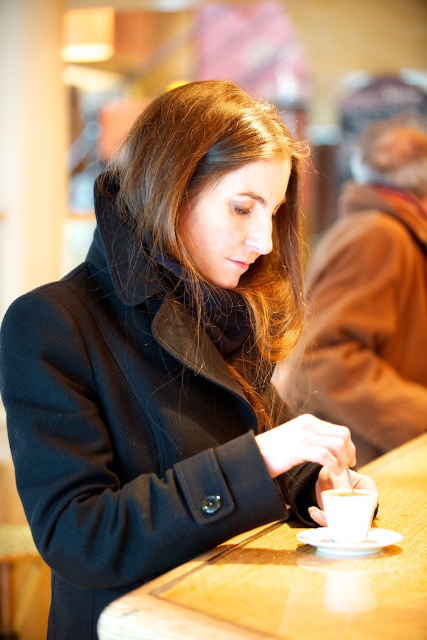
Every morning, when I am in Paris, I go downstairs to the café for breakfast, always sitting at the bar with the same regulars who, strangely, always occupy the same places. If when they arrive someone is already there, the owner just sets down their usual order at the accustomed place at the counter and they squeeze between the bodies to get to it.

The hairdresser always sits at the left end of the counter. He bought the hairdressing salon where he used to work (his former employer still lives in the same building in the flat above the salon). He could be mistaken for a college student, generally dressed in blue jeans and a Tshirt and above all speaks in a certain way….. It is not easy to differenciate between what is slang and what is invented. Each time he opens his mouth I wonder what he’ll come out with, and when he has quite finished I start thinking that I must have become a true Parisienne because I managed to understand every word. He likes to talk soccer with the chemist who came to France from Martinique and sits next to him.They compare notes about soccer and political scandals, particularly if these have made the front page of the Parisien (which the establishment kindly makes available for free to its customers).

Beside the chemist sits a young man who dabbles in the stock market. He likes to speak with them, whatever the subject, and always has a coffee, two croissants and an orange juice, then ten minutes later – surely carried away by enthusiasm- has another coffee and a pain au chocolat. He certainly doesn’t seem obsessed by health issues. Later on the three Serbian ladies who work in the jewelry store across the street come in, speaking their own language. I believe they must be happy being able to speak their mother tongue. They always seem glad to meet together. Then the owner of the algerian restaurant often comes by to have his expresso with a frown. His restaurant is famous and every evening he stands outside, full of energy, puting on a show for the tourists. Perhaps that is why he doesn’t feel like talking in the morning. Then there’s me and later on the mason. Gaston the café owner and he discovered Paris when they were seventeen. Gaston in 1961 when he arrived from his native Auvergne. He started working in another café near la place de la Bastille. Then his former boss helped him to open his own establishment. He is always happy because, he says, « it’s in my bones ». He can talk with anyone on any subject but also knows how to keep silent. He is a born diplomat. The mason arrived in 1970. They both left their familial farms because it seemed « obvious » that there would not be enough work for them there as they both came from large families. They didn’t know a thing when they arrived to Paris where they were met and welcomed by their clan, as they like to call it themselves, smiling. The bistrotiers from Auvergne and the masons from Corréze.

They talk of a Paris that no longer exists, of buses with platforms, of an epoque when all you needed to do was arrive from your hometown to be welcomed and found work by someone from your region. They talk of the present situation and what they hope to leave for their children. And all this costs me just 3 euro 30 …
Publié dans For English speakers, Life | Marqué avec , | Commentaires fermés sur Paris – Morning, in a café

Paris – Le matin, au café

English version in a few days

Chaque matin, quand je suis à Paris, je prends mon petit déjeuner au café en bas de chez moi. Toujours au comptoir, avec les mêmes habitués, qui étrangement sont toujours à la même place. Si quelqu’un est déjà là quand ils arrivent, le patron met simplement sur le comptoir ce qu’ils commandent d’habitude et ils se glissent entre les corps pour l’attraper.
Le coiffeur se met toujours au bout du comptoir à gauche. Il a acheté le salon où il travaillait (son ancienne patronne habite d’ailleurs toujours dans l’immeuble, au-dessus du salon), a l’air d’un étudiant, porte généralement un t-shirt et un jean, et surtout, parle d’une manière… C’est difficile de faire la part entre l’argot et ce qu’il invente. A chaque fois qu’il ouvre la bouche, je me demande ce qui va en sortir, et quand tout est dehors, je me dis que je dois être devenue une vraie parisienne parce que j’arrive à tout comprendre. Il aime parler de foot, avec le pharmacien qui vient de Martinique et se met à côté. De foot et des scandales politiques, surtout s’ils font la une du Parisien (que le café met gracieusement à disposition de ses clients).
A côté du pharmacien, il y a le jeune qui boursicote. Il aime discuter avec les deux autres, quelque soit le sujet, prend toujours un café, deux croissants et un jus d’orange, et dix minutes plus tard – sûrement emporté par la discussion – prend un autre café et un pain au chocolat. C’est dire s’il n’est pas obsédé par sa santé.
Après, on trouve les trois dames serbes qui travaillent à la bijouterie et parlent dans leur langue. Je me dis qu’elles doivent être heureuses de pouvoir le faire. Elles donnent toujours l’impression d’être contentes de se retrouver.
Ensuite, il y a souvent le propriétaire du restaurant algérien, qui prend son expresso l’air renfrogné. Son restaurant est célèbre, et tous les soirs, il est à l’entrée, débordant d’énergie, à faire son show pour les touristes. C’est peut-être pour ça qu’il n’a pas envie de parler le matin.
Après, il y a moi, et après, souvent, il y a le maçon. Lui et Gaston, le patron du café, ont découvert Paris quand ils avaient 17 ans. Gaston en 1961, en arrivant de son Auvergne natale. Il a commencé par travailler dans un café à la Bastille, puis son patron l’a aidé à ouvrir son propre café. Il est toujours de bonne humeur parce que comme il dit « c’est dans ma nature ». Il peut parler de tout avec tout le monde, et sait aussi très bien se taire. Il a la diplomatie dans le sang. Le maçon est arrivé en 1970. Ils ont tous les deux quittés leurs fermes familiales parce que c’était « évident » qu’il n’y aurait pas de travail pour eux. Ils ne savaient rien de rien, venaient de familles nombreuses. A Paris, ils ont été reçus par « leurs sectes », comme ils disent en souriant. Les bistrotiers auvergnats et les maçons corréziens. Ils parlent d’un Paris qui n’existe plus, des bus à plate forme, du temps où il suffisait d’arriver de sa province pour être accueilli par un membre de sa région et trouver un travail, de la situation actuelle, de ce qu’ils veulent transmettre à leurs enfants. Et tout ça ne me coûte que 3 euros 30…

Photo: Julio Piatti.

Publié dans Life | Marqué avec , , | Commentaires fermés sur Paris – Le matin, au café

Paris – Association Chirurgie Plus : Event

Scroll down for the English version

C’était dimanche dernier…

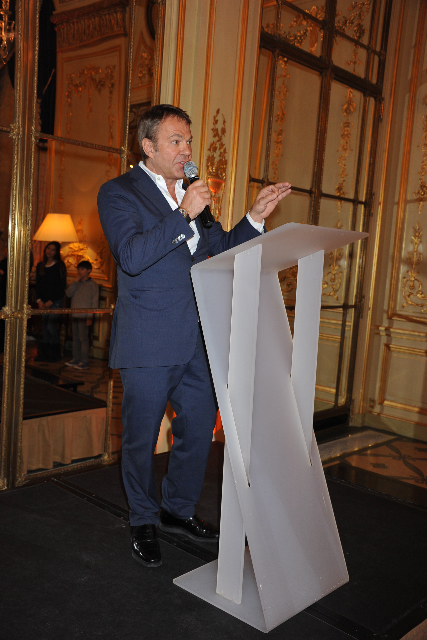
Plus de deux cents personnes sont venues soutenir l’Association Chirurgie Plus et Bertrand a fait un speech pour expliquer le but de l’association et comment s’organise la venue des chirurgiens qu’elle reçoit et forme à Paris. Peu de gens imaginent qu’un chirurgien reconnu ait encore l’occasion, ou le temps, de faire un travail humanitaire. Si Bertrand n’avait pas été mon mari, je ne l’aurais peut-être pas imaginé non plus. Mais je vois ce qu’il fait, entre ses opérations et l’association, et je sais maintenant ce que cela représente pour lui, mais surtout pour les autres. Je sais que le but de l’association est jusqu’ à maintenant atteint. Qu’elle offre chaque mois, aux chirurgiens venus de pays étrangers comme aux chirurgiens français, une vraie opportunité de partager leur savoir et leurs expériences. Et que ce partage sauve des vies. Par une action concrète, qui utilise l’argent de manière simple, sans intermédiaire, pour apprendre à des gens qui ont de vraies compétences à mieux faire face aux difficultés qu’ils rencontrent dans leurs pays et non pour leur donner seulement cet argent qu’ils ne pourront pas utiliser efficacement dans un contexte chaotique et souvent corrompu.

L’humanitaire est une notion complexe. Nous l’avons vu dans les pays où nous sommes allés, au Cambodge, au Rwanda et aussi ailleurs. Nous en sommes arrivés à la conclusion que le meilleur moyen d’aider était de faire les choses à petite échelle, avec des moyens limités et de faire surtout des choses en direct. Simplement. Des lavabos avec une cellule photoélectrique ou une connections par satellite dans des pays où il y a des pannes d’électricité à tout moment, cela n’a jamais aidé personne. L’argent que nous récoltons peut vraiment aider s’il permet de mettre en place des systèmes pratiques. Bertrand a expliqué que c’était cela, entre autre, le but de Chirurgie Plus. Quant à cet après-mdi – et sa tombola – ils ont permis de récolter de quoi faire venir, loger et former 12 chirurgiens à Paris – un par mois – durant une année. Et nous remercions encore sincèrement tous ceux qui rendent cela possible par leur implication, leur temps et leurs dons.

ASSOCIATION CHIRURGIE PLUS, Docteur Bertrand Mattéoli, Clinique de la Muette 46 rue Nicolo 75016 Paris.

It was last Sunday . . . .

More than two hundred people came to support Association Chirurgie Plus. Bertrand spoke explaining the aim of the association and how the arrival and the training of the surgeons is organized in Paris.Few people imagine that a renowned surgeon has the occasion,or the time, for humanitarian work. If Bertrand was not my husband I probably could not imagine it either. But now, I well understand how he combines his operations with the association and I know not only what that means to him but, above all, what it means to others. I know that the aims of the association have been reached till now. That every month it offers a formidable opportunity to surgeons of foreign countries to share their experience with french collegues. And that this exchange saves lives. Built on a solid basis that uses the funds in a clear and logical way, with no intermediaries, to train and enable competent collegues to face up to the difficulties they deal with in their own countries. Not to offer only money that they could not use efficiently in circumstances often chaotic and/or corrupt.

Humanitarianism is a composite conception – we have witnessed this in Cambodgia, Rwanda and elsewhere – and we have arrived to the conclusion that it is better to keep at low level, with limited means and, above all, in direct contact. Basic. Washrooms with photelectric cells, or satellite connections in places or countries where there are problems of electricity doesn’t help anyone. The money recieved can only, truely help if put to practical purposes. Bertrand explained that this, amongst others, is one of the aims of Chirurgie Plus.

That afternoon, and the tombola, raised enough to pay the voyage, the accommodation and the training of twelve surgeons in Paris – one a month – during one year.And we thank again, sincerely, all those who have made this possible by their precious support, their time and their generosity.

ASSOCIATION CHIRURGIE PLUS, Docteur Bertrand Mattéoli, Clinique de la Muette 46 rue Nicolo 75016 Paris.

Publié dans Association Chirurgie Plus, For English speakers, Life, News | Marqué avec | Commentaires fermés sur Paris – Association Chirurgie Plus : Event